HMRC National Minimum Wage Enquiry: Small Business Case Study
HMRC National Minimum Wage Enquiry: Small Business Case Study
Date Posted:
The Letter Every Small Business Owner Dreads
Most small business owners do not spend their evenings studying National Minimum Wage legislation. They are busy serving customers, managing staff, paying suppliers, chasing invoices and dealing with the countless challenges that come with running a business.
They do not have an in-house HR department, a compliance team or employment lawyers on standby. Nor do they have unlimited time or a large budget available for professional fees if an HMRC enquiry becomes lengthy or complicated.
That was the position faced by one of our clients when an unexpected letter from HMRC arrived. The business had been selected for a National Minimum Wage compliance check. HMRC wanted to understand how employees had been paid, how their working hours had been recorded and what evidence the business could produce to support its payroll records.
The owner was understandably concerned. Had somebody made a complaint? Had the business done something wrong? How far back would HMRC look? What documents would need to be provided? How much time would the enquiry take? Most importantly, how could the owner respond properly while continuing to run the business?
The client believed that its employees had always been paid fairly. Our subsequent review supported the position that the workers concerned had been paid above the applicable National Minimum Wage rates. However, the enquiry exposed an important distinction that every employer should understand:
Payroll compliance is not judged only by what you paid. It can also depend on what you can prove.Paying workers correctly is essential, but employers must also retain the records needed to demonstrate National Minimum Wage compliance.
The Common Misconception About National Minimum Wage Compliance
Many employers assume that National Minimum Wage compliance is straightforward. If an employee’s monthly salary or hourly rate appears comfortably above the statutory minimum, the employer may conclude that there cannot be a problem.
In practice, HMRC does not necessarily look at the headline payroll figure in isolation. It may examine the working arrangements and evidence sitting behind that figure.
For example:
How many hours did the employee actually work?
Were breaks paid or unpaid?
Did the employee carry out work before opening or after closing?
Was any travelling or training time treated correctly?
Were deductions made from the employee’s pay?
Did the employee have to purchase clothing, equipment or anything else connected with the job?
Which pay reference period did the payment relate to?
Is there evidence showing when and how the employee received the money?
Can the employer produce the relevant employment contract, payslip and time record?
A salary may appear comfortably above the National Minimum Wage. However, without reliable evidence of the hours to which that salary relates, demonstrating compliance can become much more difficult.
HMRC guidance confirms that employers must keep sufficient records to demonstrate that their workers have been paid at least the National Minimum Wage. Records do not have to be kept in one prescribed format, but they must support the employer’s position. Relevant records can include PAYE information, employment contracts, timesheets, staff rotas, attendance records, cash books and bank statements.
Some of the most difficult National Minimum Wage enquiries do not begin with clear evidence that an employee was underpaid. They begin with a gap between what the employer believes happened and what the surviving records can demonstrate several years later.
Why Employers Should Take HMRC National Minimum Wage Checks Seriously
It is easy to assume that National Minimum Wage enforcement is aimed only at employers who deliberately exploit or underpay their workers. The published figures tell a more complicated story.
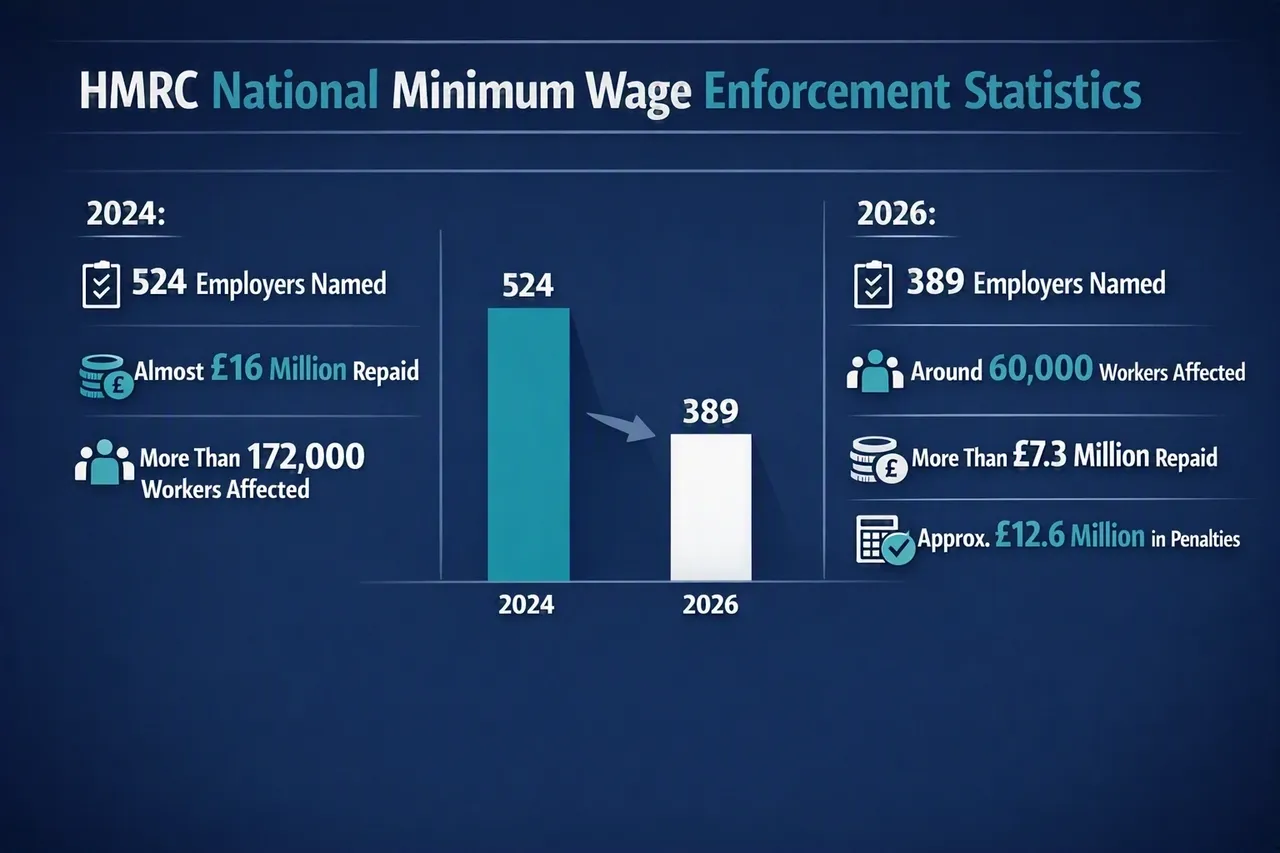
In February 2024, the Government publicly named 524 employers that had failed to comply with National Minimum Wage requirements. Those employers were required to repay almost £16 million to more than 172,000 workers, with additional financial penalties imposed. The underlying HMRC investigations concluded between 2015 and 2023. [gov.uk]
In March 2026, the Government announced that a further 389 employers had been named for underpaying workers. Around 60,000 workers were affected, more than £7.3 million in wages was repaid and approximately £12.6 million in penalties was issued. [gov.uk]Government enforcement figures show the scale of National Minimum Wage compliance risk, with hundreds of employers named and millions repaid to workers.Government enforcement figures show the scale of National Minimum Wage compliance risk, with hundreds of employers named and millions repaid to workers.
The employers named have included businesses from a wide range of sectors, as well as recognisable national brands. Size and reputation do not provide protection from National Minimum Wage errors.
Importantly, not every breach results from an employer deliberately deciding to pay less than the legal minimum. Common problems can include:
Inadequately recorded working time.
Unpaid work carried out before or after a shift.
Incorrectly rounded working hours.
Deductions from pay for items such as uniforms or equipment.
Errors involving salary sacrifice.
Incorrect apprentice rates.
Failure to increase wages when a worker reaches a relevant age threshold.
Failure to implement the annual National Minimum Wage rate increase correctly.
An employer can therefore believe that its payroll is compliant and still be caught out by the way working time, deductions or pay arrangements have been treated. The lesson is not that every employer should expect the worst. It is that National Minimum Wage compliance requires more than checking the rate stated on a payslip.
The Initial HMRC National Minimum Wage Check
HMRC’s initial letter informed the owner that the business had been selected for a National Minimum Wage check. Before requesting specific documents, the compliance officer proposed a detailed discussion about the business, its workers, its payroll arrangements and the records available.
HMRC explained that it might need to see:
Gross pay records and payslips.
Records of hours worked.
Evidence of payments made to workers.
Employment contracts.
Worker details.
Evidence supporting any exemption from National Minimum Wage requirements.
The letter also indicated that HMRC expected to speak to workers as part of its enquiries.
For a large organisation, locating this information may primarily be an administrative exercise. For the owner of a small business, it can become a major distraction. The owner still has customers to serve, suppliers to manage and a business to operate. There is no spare compliance department waiting to reconstruct years of employment history.
Our objective was therefore not simply to address the technical issues. It was to deal with the enquiry in a focused, organised and proportionate way, limiting the disruption for an owner who still had a business to run.
What Made the Case More Complicated?
The payroll records showed the gross and net amounts paid to the employees, but did not always contain detailed information about the hours underlying those payments, as the employees were not required to submit timesheets.
This did not automatically mean that anyone had been underpaid. It did, however, mean that payroll records could not be considered in isolation. We needed to understand the employees’ actual working patterns, the basis on which their pay had been calculated and the supporting evidence retained by the business.
The position involved:
Former employees whose arrangements had to be examined retrospectively.
Changes in working hours over time.
Monthly payroll records.
Weekly cash payments made towards an employee’s monthly wage.
Historical employment contracts.
Attendance and absence records.
National Minimum Wage rates that had changed during the period being considered.
None of those factors necessarily demonstrated non-compliance. Taken together, however, they created a historical position that needed to be carefully reconstructed and clearly explained.
Looking only at a payroll report would not tell the entire story.
Our First Step: Establishing the Facts
We became involved at an early stage and carried out a detailed review of the available payroll and employment records. We worked through the available evidence and sought to understand how the employment arrangements had operated in practice.
Our work included:
Reviewing historical payroll reports and payslips.
Establishing the relevant employee working arrangements.
Comparing pay against the applicable National Minimum Wage rates.
Understanding changes to employees’ hours.
Reviewing records of cash payments.
Considering available attendance and absence records.
Reviewing employment contracts and supporting documentation.
Discussing the arrangements with the business owner.
Identifying areas where further evidence or explanation might be required.
The review supported the business’s position that no National Minimum Wage arrears had been identified. That position was reflected in the declaration submitted to HMRC and explained during the subsequent compliance meeting.
Completing the National Minimum Wage Declaration
Before the formal compliance meeting, the business completed an HMRC National Minimum Wage declaration following a self-review of its payroll processes. The declaration confirmed that the review had not identified any National Minimum Wage arrears for the workforce.
A declaration of this nature should never be treated as a box-ticking exercise. Before making a statement to HMRC, an employer should have a reasonable basis for the conclusion reached. That means reviewing the records, understanding the working arrangements and considering whether different National Minimum Wage rules could affect the calculation.
HMRC’s declaration form also makes clear that acceptance of a declaration does not, by itself, guarantee National Minimum Wage compliance. Our role was to help the client understand the basis of its declaration and ensure the underlying position could be properly explained if HMRC asked further questions.
That became particularly important when HMRC proceeded with a formal compliance meeting.
Representing the Client During the HMRC Compliance Meeting
The HMRC meeting lasted nearly an hour and covered considerably more than the figures appearing on payroll reports.
The owner attended alongside representatives from ATS Accountants. This meant the client did not have to face a detailed HMRC interview without professional support.
During the meeting, HMRC asked about:
The nature and history of the business.
The composition of the workforce.
Current and former employees.
Contracted and actual working hours.
Breaks and holiday arrangements.
Payroll software and procedures.
Pay reference periods.
The frequency and method of employee payments.
Cash payment arrangements.
Deductions from employees’ wages.
Employment contracts.
Time and attendance records.
The documents retained by the business.
We explained the payroll arrangements, clarified how employee pay had been calculated and provided context about how the business operated.
This professional representation served two purposes.
Firstly, it helped HMRC receive relevant and properly organised information.
Secondly, it reduced the pressure on the owner, who could rely on advisers already familiar with the payroll records and the technical issues involved.
For an experienced HMRC compliance officer, the meeting forms part of their day-to-day work. For a small business owner, it may be the first time they have ever been questioned about employment practices going back several years.
Having experienced advisers present can make the process far more manageable.
What Records Did HMRC Ask to See?
Following the meeting, HMRC issued its notes and requested additional documents.
These included:
Employment contracts for two former employees.
Payslips for one former employee covering the requested period.
Corresponding records of working time.
Records showing cash payments made to the employee.
This illustrates why a National Minimum Wage check is often as much a record-keeping enquiry as a payroll enquiry. A payslip shows what was processed through payroll. On its own, it may not prove:
The hours actually worked.
Whether additional working time existed.
Whether breaks were included.
When a cash payment was received.
Which pay reference period the payment related to.
Whether deductions or worker expenditure affected minimum wage pay.
HMRC’s guidance states that records covered by the rules applying from April 2021 must generally be retained for a minimum of six years, calculated from the prescribed point after the relevant pay reference period.
For small employers, this can mean producing evidence relating to employees who left the business years earlier.
Why Digital Record Keeping Matters
One of the most important lessons from this case is that payroll documents should not depend on the owner locating an old paper file, searching through a dormant email account or trying to remember an employee’s usual hours several years after they left.
At ATS Accountants, we take a proactive approach to digital record keeping across our payroll client base.
Payslips and payroll reports are stored digitally in the cloud as part of the payroll process. This creates a more organised and retrievable record than relying solely on paper documents held at a client’s business premises. However, digital payslips are only one part of the evidence.
We also encourage employers to retain appropriate supporting records, including:
Signed employment contracts and subsequent amendments.
Time and attendance records.
Start and finish times where relevant.
Records distinguishing paid and unpaid breaks.
Holiday and absence records.
Evidence of payments made outside the normal bank payroll process.
Signed acknowledgement of cash wage payments.
Records of deductions, reimbursements and worker expenses.
Documentation supporting changes in pay or hours.
Relevant correspondence concerning an employee’s working arrangements.
Cloud storage cannot correct an inaccurate payroll or replace a missing record of working time. What it can do is create a clearer audit trail and make retained information easier to locate if questions arise later.
The principle is simple: Records should be stored when they are created, not reconstructed when HMRC asks for them.
That is part of the proactive support we seek to provide to our clients. The time to discuss record keeping is not after an enquiry letter arrives.
The Outcome
Our review and the declaration submitted to HMRC supported the position that the business had not identified any National Minimum Wage arrears.
The process did, however, identify opportunities to strengthen the client’s records.
HMRC recommended that any future employees should sign in and out, or otherwise confirm the hours they had worked. HMRC also recommended maintaining stronger acknowledgement records where workers are paid in cash, including details such as the worker’s name, the date, the amount and the worker’s signature.
These were practical improvements aimed at the evidence that had been more difficult to demonstrate retrospectively. The value of our involvement was therefore not limited to dealing with HMRC’s immediate questions. We helped the owner:
Understand what HMRC was examining.
Review the historical payroll position.
Prepare for the compliance meeting.
Explain the business’s working and payment arrangements.
Organise the records requested.
Identify improvements that could reduce future risk.
The immediate objective was to respond properly to HMRC.
The longer-term objective was to leave the business with stronger procedures than it had before the enquiry began.
Five Lessons for Employers
1. Paying Above the National Minimum Wage Is Not the End of the Calculation: A headline hourly rate or monthly salary does not necessarily settle the question. Working time, pay reference periods, deductions and certain employment-related payments or costs may affect whether the legal minimum has been met.
2. Payroll and Time Records Should Work Together: A payslip demonstrates what has been processed through payroll. A time record helps demonstrate the hours to which that payment relates. Where pay is at or close to the statutory minimum, accurate time records become particularly important.
3. Cash Wages Require a Clear Audit Trail: Paying wages in cash does not, by itself, mean that an employee has been underpaid. However, an employer should retain clear evidence of the worker’s name, payment date, amount paid and receipt of the money. Without that evidence, a future disagreement can become much harder to resolve.
4. Do Not Rely on Memory: An informal arrangement may be understood perfectly by both the owner and the employee at the time. Several years later, the employee may have left, the working pattern may have changed and neither party may remember every detail. Contemporaneous records carry far more weight than retrospective recollections.
5. Seek Advice Before Responding in Detail: An employer should understand what HMRC is requesting, review the position and organise the supporting evidence before providing substantive answers. Early professional advice can help identify gaps, avoid inconsistent explanations and keep the enquiry focused.
The Bigger Lesson for Small Businesses
There is a tendency to imagine every compliance failure as a deliberate act by an employer who knowingly ignored the rules. The reality is often less dramatic. A business can pay its employees fairly, operate in good faith and still find it difficult to demonstrate the precise position years later.
The risk may arise not from the amount paid, but from informal procedures, incomplete time records or evidence stored in several different places. That does not make record keeping a minor administrative matter. When HMRC asks questions, the quality of a business’s records may determine:
How quickly the employer can respond.
How much professional support is required.
How disruptive the enquiry becomes.
Whether the employer can confidently demonstrate its position.
For a small employer, that really matters. Every hour spent searching for an old contract, reconstructing working hours or explaining an undocumented cash payment is an hour not spent serving customers or running the business.
Good digital records will not eliminate every compliance risk. They can, however, reduce avoidable cost, uncertainty and stress. Most employers think payroll compliance is about paying people correctly.
HMRC looks beyond the payment itself.
Paying workers correctly is essential, but compliance does not end when wages are paid. It extends to the records retained, the systems used and the employer’s ability to demonstrate what happened years later.
In our experience, some of the most difficult enquiries are not those involving deliberate underpayment. They are the cases where the employer tried to do the right thing, but the records needed to support its position are incomplete, inconsistent or difficult to retrieve. That is why good digital record keeping is not simply an administrative task.
It is a form of business risk management.
How ATS Accountants Can Help
An HMRC compliance letter does not automatically mean that a business has underpaid its employees or done something wrong. It does mean that the employer should take the request seriously. At ATS Accountants, we support employers with:
HMRC National Minimum Wage enquiries.
PAYE compliance checks.
Payroll compliance reviews.
National Minimum Wage self-reviews.
Historical payroll analysis.
Preparation for HMRC meetings.
Professional representation during compliance enquiries.
Digital delivery and retention of payroll reports and payslips.
Improvements to payroll and employment record-keeping procedures.
Ongoing payroll and business advisory services.
If your business receives an HMRC National Minimum Wage enquiry letter, we can help you understand what HMRC is asking for, review the available evidence and present your position clearly. Book a free consultation –Contact ATS Accountants
Because when HMRC asks questions, confidence does not come simply from believing you complied with the rules.
It comes from being able to prove it.This case study has been anonymised to protect client confidentiality. Certain identifying details have been omitted. The circumstances and outcome of every HMRC enquiry will depend on the specific facts of the case.